




Recoil Script and Aimbot: Technical Explanation and How They Work
- Introduction: What Are Recoil Scripts and Aimbots, and Why Do They Matter?
- How the Recoil System Works in Game Engines
- Deterministic Recoil Pattern Model
- Recoil Vector and Time Series
- Technical Architecture of Aimbot Systems
- Aimbot Types and Operating Principles
- Coordinate Transformation and Aiming Calculation
- How Recoil Scripts Work: Step-by-Step Technical Explanation
- Step 1: Analysis of Weapon Recoil Pattern
- Step 2: Determining Timing Parameters
- Step 3: Calculating the Counter-Movement Vector
- Step 4: Mouse Input Simulation
- Step 5: Dynamic Calibration and Sensitivity Adjustment
- Step 6: Aimbot Integration and Synchronization
- Step 7: Testing, Validation, and Fine-Tuning
- Fundamental Differences Between Aimbot and Recoil Script
- Functional Distinction
- Technical Complexity Comparison
- How Anti-Cheat Systems Detect These Mechanics
- Behavioral Analysis Methods
- Kernel-Level Protection and Memory Monitoring
- Technologies Used in Recoil Script Development
- Programming Languages and Tools
- Data Sources and Pattern Databases
- Benefit and Risk Assessment
- Technical Learning Value
- Risk Factors
- Conclusion
- Are recoil scripts and aimbots the same thing?
- Which games do recoil scripts work on?
- How do anti-cheat systems detect recoil scripts?
- Is cheating a violation of others' rights?
- Does using a recoil script result in account ban?
- Which programming language is recommended for writing recoil scripts?
Introduction: What Are Recoil Scripts and Aimbots, and Why Do They Matter?
Competitive multiplayer games have undergone an incredible evolution in recent years, both in technical depth and gameplay complexity. Titles like PUBG, Valorant, CS2, and Warzone now require far more than just reflexes; they demand knowledge of weapon mechanics, map control, and equipment management working in tandem. At the heart of this complexity, two concepts stand out: recoil and aimbot (automatic aiming). Understanding how these two concepts relate to each other, how game engines model these systems, and how they're handled at the software level is incredibly enlightening for both game developers and technical users interested in game mechanics.
The recoil system is a collection of mechanics integrated into game engines to simulate real-world weapon physics. When a weapon fires, the barrel deviates in a specific direction—typically upward and slightly to the side. This deviation follows a particular path in-game, known as a "recoil pattern." Each weapon has its own unique recoil pattern, and while these patterns vary from game to game, they fundamentally follow a deterministic—meaning repeatable and predictable—structure.
Aimbot, on the other hand, is a broader concept. In its basic sense, it's a general term for software components that automate or assist the targeting process. However, aimbot alone doesn't mean much; its effectiveness truly emerges when combined with recoil control. Being able to aim but not control recoil means you can't land accurate shots in practice. This is why, at a technical level, these two systems complement each other.
In this article, we'll explore how recoil systems are modeled in game engines, the technical differences between aimbot and recoil scripts, the software architecture of these systems, and how they work step by step. We'll also examine how anti-cheat systems detect these mechanics and what they mean for game security. This comprehensive guide addresses readers at all levels interested in taking a technical approach to game mechanics.
If you're researching these topics and interested in tools that provide advantages in competitive gaming, our article on Top 10 Gaming Cheat Tools and Usage Guide will also provide you with a comprehensive overview. Now let's dive into the technical details.
Summary: A recoil script is a software component that models in-game weapon recoil. Aimbot is an automatic aiming system. When working together, they provide both aiming and recoil control. This article explains the technical architecture of these systems step by step.
How the Recoil System Works in Game Engines
Deterministic Recoil Pattern Model
The vast majority of modern competitive games apply recoil using a deterministic model rather than a random one. This means that with each shot, the aiming point moves along a predefined path. For example, in CS2, the M4A4 weapon has a fixed pattern for the first 30 bullets; this pattern can be memorized by players and controlled manually through counter-strafing.
This deterministic structure is created by the game engine calculating the weapon's "spread" and "recoil" values separately for each frame. Spread refers to the random deviation of the bullet as it leaves the barrel, while recoil determines how much the camera or aiming point shifts. The two are calculated independently but applied simultaneously in the end.
Recoil Vector and Time Series
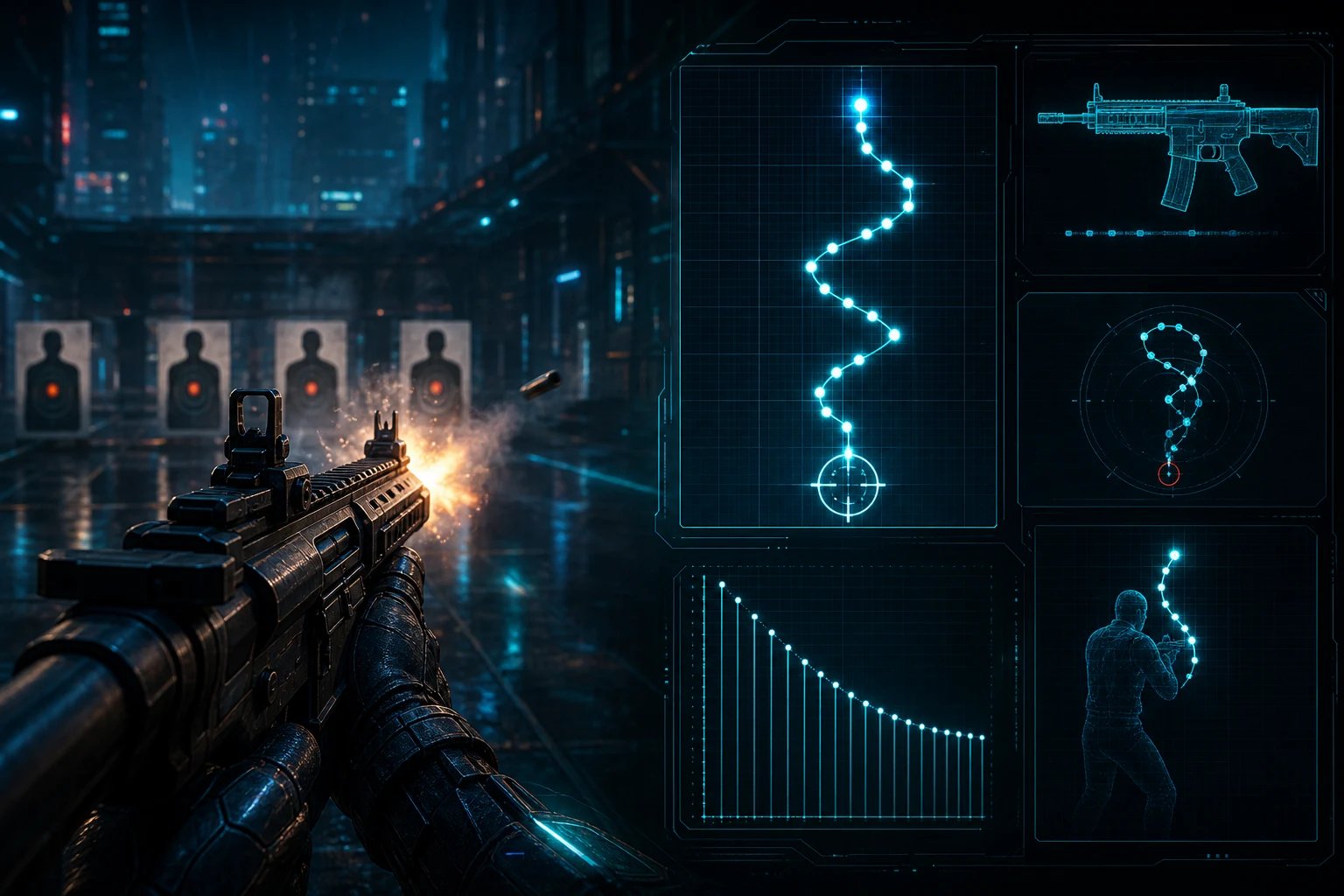
At a technical level, the recoil system can be modeled as a time series vector. At each firing moment (t₀, t₁, t₂...), the delta-X and delta-Y values to be applied to the aiming point have been pre-calculated. These values are typically stored as an array in the game's data files or memory space. The software accesses this array to know exactly which direction and how much deviation will occur with each shot.
Understanding this structure is critical to grasping how recoil scripts work. Essentially, a recoil script attempts to neutralize recoil by applying this vector series in reverse.
Technical Architecture of Aimbot Systems
Aimbot Types and Operating Principles
Aimbot software can be divided into several different categories from a technical implementation perspective. The most basic distinction relates to how the system accesses game data:
Memory-based aimbot: Directly accesses enemy coordinate data stored in the game's RAM to calculate target position. This method requires deep integration with game processes and carries the risk of detection by anti-cheat systems.
Image processing-based aimbot: Detects enemy characters by analyzing screen captures or GPU output. This method avoids touching game memory, making it harder to detect, but suffers from computational latency disadvantages.
Coordinate Transformation and Aiming Calculation
The fundamental mathematical operation of an aimbot is transforming 3D world coordinates into 2D screen coordinates. This is accomplished by applying the inverse of the projection matrix used by the game. Once the target's position in world space (X, Y, Z) is known, the game's camera matrix is used to convert this position to pixel coordinates on screen, and the mouse is directed to that point.
In this calculation process, variables such as FOV (Field of View), camera angle, player position, and target position are used together. The resulting delta values are converted into mouse movements and applied. Advanced versions of aimbots perform this movement along a human-like curve (such as a Bezier curve) to appear more natural.
For those wanting to learn more on this topic, we recommend reviewing our article on Top Aimbot Software for Gaming and Usage Tips.

How Recoil Scripts Work: Step-by-Step Technical Explanation
-
Step 1: Analysis of Weapon Recoil Pattern
The first step in developing a recoil script is to accurately analyze the target weapon's recoil pattern. This analysis typically takes place in in-game test environments (training mode or shooting range). By firing continuously at a fixed point, the path traced by the aiming point is recorded. This path is expressed as a (ΔX, ΔY) pair for each shot and forms an array. In some games, this pattern can be read directly from game files, while in others, experimental measurement is required.
-
Step 2: Determining Timing Parameters
To correctly apply the recoil pattern, the weapon's fire rate and the time interval between each shot (in milliseconds) must be known precisely. This value determines when and how much mouse movement the script will apply. Incorrect timing can worsen recoil rather than correct it. Fire rate is typically expressed as rounds per minute (RPM), and the interval in milliseconds is calculated accordingly.
-
Step 3: Calculating the Counter-Movement Vector
For each (ΔX, ΔY) value in the recoil pattern, an opposite counter-movement vector (-ΔX, -ΔY) is calculated. This counter-movement must be applied at the exact moment the recoil occurs. The timing of application is critical: if applied too early, the aim drifts below the target; if too late, the recoil has already happened. Therefore, the script must work synchronized with the game's firing cycle.
-
Step 4: Mouse Input Simulation
The calculated counter-movement vectors are simulated as mouse input at the operating system level. In Windows environments, this is typically done through SendInput() or mouse_event() API calls. However, this method can be easily detected by anti-cheat systems. More advanced implementations use external devices or drivers that simulate mouse input at the hardware level (via USB HID protocol). This approach significantly complicates software-based detection.
-
Step 5: Dynamic Calibration and Sensitivity Adjustment
Each player has different mouse sensitivity (sensitivity) and DPI settings. The recoil script must scale the movement it applies according to these values. For example, for a player using high DPI, even a small pixel movement can mean a large aiming shift. Therefore, the user's in-game sensitivity value and DPI information should be provided as input to the script, and all delta calculations should be normalized accordingly. Advanced scripts can perform this calibration automatically.
-
Step 6: Aimbot Integration and Synchronization
A recoil script can work standalone, but becomes much more effective when integrated with an aimbot system. In this integration, the aimbot detects the target and directs the aim to that point, while the recoil script ensures the aim doesn't drift from the target during firing. For the two systems to work synchronized, a common trigger mechanism is used. This mechanism is typically an event listener that monitors when the fire button is pressed.
-
Step 7: Testing, Validation, and Fine-Tuning
The developed script must undergo comprehensive testing in the game's training mode. Separate tests should be conducted for different ranges, different firing durations (burst vs. full-auto), and different movement states (stationary, walking, running). Since the recoil pattern changes during player movement in some games, this condition must be addressed separately. Based on test results, timing and scaling parameters are fine-tuned and adjusted.
Fundamental Differences Between Aimbot and Recoil Script
Functional Distinction
Although these two systems are often confused, their functions are fundamentally different. Aimbot manages the targeting process: it detects enemies and directs the aim toward them. Recoil script keeps the aim steady during firing. To use an analogy: aimbot is the GPS that gets you to the target, while recoil script is the vibration dampening system in a vehicle.
The practical importance of this distinction is this: Using a recoil script without aimbot ensures the weapon doesn't recoil while aiming manually. Using aimbot without a recoil script directs the aim at the target but loses control during firing. Using both together solves both problems simultaneously.
Technical Complexity Comparison
Recoil script is technically a simpler system. Essentially, it converts a pre-determined pattern data into mouse movements at specific timing intervals. This process doesn't require access to game memory; mouse input simulation alone is sufficient. Aimbot, on the other hand, requires a much more complex architecture: it includes components such as 3D coordinate reading, projection calculation, target detection, and motion prediction.
This complexity difference also affects detection risk. Recoil scripts leave a lower profile since they only simulate mouse input. Aimbots require memory access, making them a more prominent target on anti-cheat systems' radar.

How Anti-Cheat Systems Detect These Mechanics
Behavioral Analysis Methods
Modern anti-cheat systems (Vanguard, BattlEye, VAC, EAC) use multiple layered strategies to detect such software. The first layer is signature-based detection: known malicious software code signatures are compared against a database. However, this method is ineffective against new or custom-developed tools.
The second and more sophisticated layer is behavioral analysis. Mouse movement patterns are analyzed statistically. Human mouse movement includes characteristic "jitter" (tremor) and variable speed profiles. Movements generated by software typically exhibit either perfect smoothness or a specific mathematical pattern. This abnormality can be detected with high accuracy using machine learning models.
Kernel-Level Protection and Memory Monitoring
Kernel-level anti-cheat systems like Valorant's Vanguard create a protection layer that extends down to the operating system kernel. These systems monitor all software interacting with the game process, block unauthorized memory read/write operations, and verify driver signatures. Detection at this level creates a serious barrier for the vast majority of aimbots and recoil scripts.
However, security researchers and advanced users have demonstrated that these systems also have exploitable vulnerabilities. Hardware-level mouse simulation, DMA (Direct Memory Access) cards, and virtualization techniques are among the methods used for this purpose. Indeed, products like Cougar Bypass offer such advanced bypass mechanisms.
For more information on minimizing detection risk and safe usage practices, check out our article on How to Prevent the Most Common Mistakes in Gaming Cheats.
Technologies Used in Recoil Script Development
Programming Languages and Tools
The main programming languages and tools used for recoil script development are: Lua (built-in script support in Logitech G-Hub and similar mouse software), AutoHotkey (a commonly used scripting language for keyboard/mouse automation in Windows), Python (for mouse control via PyAutoGUI or pynput libraries), and C/C++ (for low-level, high-performance implementations).
Each language has its advantages and disadvantages. Lua and AutoHotkey stand out for ease of use and speed. Python enables image processing integration thanks to its extensive library ecosystem. C/C++ provides the lowest latency and deepest system integration.
Data Sources and Pattern Databases
Recoil patterns can be obtained from databases created by gaming communities over many years. Recoil patterns for CS2 are documented with near-pixel perfection. Similar resources exist for PUBG and Warzone. This data provides script developers with a ready starting point without needing to measure each weapon separately.
On the other hand, game updates can change these patterns. Therefore, professionally developed tools include mechanisms that automatically update the pattern database. Products like Ph Spoofer and PH are examples of tools with such continuous update infrastructure.
Benefit and Risk Assessment
Technical Learning Value
Technical examination of these systems provides valuable insights in the fields of game security, software engineering, and human-computer interaction. Game developers can design more effective anti-cheat systems by understanding these mechanics. Security researchers can contribute to gaming ecosystem security by reporting these vulnerabilities.
Risk Factors
Using such tools in competitive games carries serious risks. Account bans, permanent hardware bans, loss of community trust, and in some cases legal consequences are among these risks. Particularly in tournaments or prize-based competitions, using such tools is considered an ethical violation and can result in severe penalties.
For a safe and trouble-free experience, preferring professionally developed tools like GANTE Full or Ph Esp that are regularly updated and include anti-cheat bypass mechanisms significantly reduces detection risk.
Conclusion
Recoil script and aimbot represent two of the most technical dimensions of game mechanics. As we've covered in this article, the recoil system is built on a deterministic recoil pattern that can be mathematically modeled and applied in reverse. Aimbot is built on a complex calculation infrastructure that transforms 3D world coordinates into 2D screen coordinates. The integration of both systems provides a comprehensive solution for both aiming and recoil control.
From a technical perspective, developing these systems requires serious software engineering knowledge. Timing precision, coordinate transformations, mouse input simulation, and anti-cheat bypass mechanisms demonstrate how deep a specialized field this is. From a game security perspective, these systems represent an ever-evolving cat-and-mouse game: as anti-cheat systems evolve, these tools become more sophisticated.
The most important advice for readers interested in this topic is this: acquiring and understanding technical knowledge is always valuable. However, how this knowledge is used has both ethical and practical consequences. For a sustainable experience in the competitive gaming ecosystem, preferring reliable, up-to-date, and professionally developed tools reduces detection risk and provides more stable performance. The product range on ForceCheat.net offers solutions that meet these criteria.
Finally, it should be noted that the technical information covered in this article has been shared for educational and research purposes. Understanding game mechanics helps both players and developers make more informed decisions. If you continue to be interested in this topic, we recommend reviewing our other technical content and visiting our product pages.
Are recoil scripts and aimbots the same thing?
No, they are different systems. A recoil script automates mouse movement to neutralize weapon recoil. Aimbot detects targets and directs the aim toward them. When used together, they provide both aiming and recoil control, but their technical architectures and functions are different.
Which games do recoil scripts work on?
Recoil scripts can theoretically be applied to any game that uses a deterministic recoil pattern. CS2, PUBG, Valorant, Warzone, and Apex Legends are among the leading examples. However, each game has a different recoil pattern and the script must be calibrated specifically for that game. Since game updates can change patterns, scripts also need regular updates.
How do anti-cheat systems detect recoil scripts?
Anti-cheat systems detect deviations from human movement by statistically analyzing mouse movement patterns. Movements generated by software typically exhibit perfect smoothness or specific mathematical patterns. Additionally, kernel-level systems monitor unauthorized memory access and suspicious processes. Hardware-level simulation makes software-based detection more difficult.
Is cheating a violation of others' rights?
This is a question with both religious and ethical dimensions. From an Islamic perspective, violating others' rights, gaining unfair advantage, or deceiving can be considered a violation of others' rights. Using such tools in competitive games can undermine other players' right to fair competition. Therefore, personal responsibility and ethical evaluation are of great importance in this regard. Single-player or educational use requires different ethical consideration.
Does using a recoil script result in account ban?
Yes, using a recoil script in competitive games can result in account ban if detected. In some games, this ban can become a permanent hardware ban. To minimize risk, it's important to prefer professionally developed tools that are regularly updated and include anti-cheat bypass mechanisms. Additionally, usage frequency and intensity are factors that affect detection risk.
Which programming language is recommended for writing recoil scripts?
For beginners, AutoHotkey or Lua (via Logitech G-Hub) are the most accessible options. For intermediate level, Python is a good choice with broad library support. For professional and low-latency implementations, C/C++ is preferred. The choice should depend on the use case, target platform, and developer experience.
Share this post
Top 10 Game Cheating Tools and Usage Guide
Unforgettable Gaming Cheats: Best Cheat Conditions and Strategies
// related posts
Related Posts
Marvel Rivals Aimbot Experience: The Path to Quick Wins
Discover how aimbot and other cheat tools work in Marvel Rivals, which features will give you the edge, and how to choose the right tool for your playstyle.
October 9, 2026
Rust ESP Map Control: Seeing Enemy Positions in Advance
Master map control in Rust using ESP to see enemy positions beforehand. Discover optimal settings, profiles, and strategies for dominating the game in this comprehensive guide.
October 8, 2026

PUBG Final Circle: Best Settings and Strategies to Win
Struggling in PUBG's final circle? Master the right cheat settings and configurations to turn every endgame in your favor. Complete guide to dominating the final zone.
October 8, 2026