



Aimbot Technology: How It Works & 9 Advanced Techniques
- Introduction: What is Aimbot and Why Is It So Powerful?
- Technical Foundations of Aimbot: Game Memory and Coordinate Systems
- 9 Core Aimbot Techniques: Detailed Analysis
- 1. Memory-Based Aimbot
- 2. Screen-Based Aimbot
- 3. Triggerbot
- 4. Silent Aim
- 5. Bone-Based Aimbot
- 6. Prediction Aimbot
- 7. FOV Aimbot
- 8. Smoothing Aimbot
- 9. AI-Based Aimbot
- Anti-Cheat Systems and Bypass Methods
- Major Anti-Cheat Systems
- Behavioral Analysis and Machine Learning
- Aimbot Development: Technical Requirements
- Programming Languages
- Essential Libraries and Tools
- Mathematical Foundation
- Ethical and Legal Dimensions
- Conclusion: The Future of Aimbot Technology
- Frequently Asked Questions (FAQ)
- Is aimbot legal?
- Can aimbot bypass anti-cheat systems?
- Which type of aimbot is hardest to detect?
- Which programming language should be learned to develop aimbot?
- Why is prediction aimbot superior to others?
Introduction: What is Aimbot and Why Is It So Powerful?
In the competitive gaming world, the term "aimbot" stands as one of the most feared and most intriguing concepts. But what exactly is an aimbot, how does it really work, and what engineering decisions lie behind this technology? These questions deeply concern both gaming security enthusiasts and developers who want to create their own cheat software. At its simplest, an aimbot is a software component that automates or significantly facilitates a player's aiming process. However, this definition barely scratches the surface.
A modern aimbot is a complex software system that detects enemy player screen coordinates or 3D positions in game memory, processes this data in real-time, calculates mouse movement, and accomplishes all of this in a fraction of a second. In this article, we'll provide a comprehensive guide from the fundamentals of aimbot technology to the most advanced techniques.

- Aimbot is a software component that automates aiming in games.
- Nine fundamental techniques exist: Memory-based, Screen-based, Triggerbot, Silent Aim, Bone Aimbot, Prediction Aimbot, FOV Aimbot, Smoothing Aimbot, and AI-based Aimbot.
- Each technique has different advantages, disadvantages, and detection risks.
- Anti-cheat systems are constantly evolving; modern aimbots use sophisticated methods to bypass these systems.
- From a software development perspective, aimbot technology requires advanced memory management, 3D mathematics, and real-time processing optimization.
Technical Foundations of Aimbot: Game Memory and Coordinate Systems
To understand how an aimbot works, you first need to understand how modern FPS (First Person Shooter) games operate. Every game creates a series of data structures in the computer's RAM while running. These data structures contain 3D coordinates of enemy players, health values, bone positions, and much more information.
The basic aimbot loop consists of these steps:
- Target Detection: Identifying the location of enemy players on screen or in memory.
- Angle Calculation: Trigonometrically calculating the difference between the player's current view angle and the target's position.
- Mouse Movement: Converting the calculated angle difference into mouse movement.
- Application: Sending the mouse movement to the game (directly or indirectly).
This loop typically repeats dozens to hundreds of times per second, allowing the aimbot to achieve precision far beyond human reflexes.
9 Core Aimbot Techniques: Detailed Analysis
1. Memory-Based Aimbot
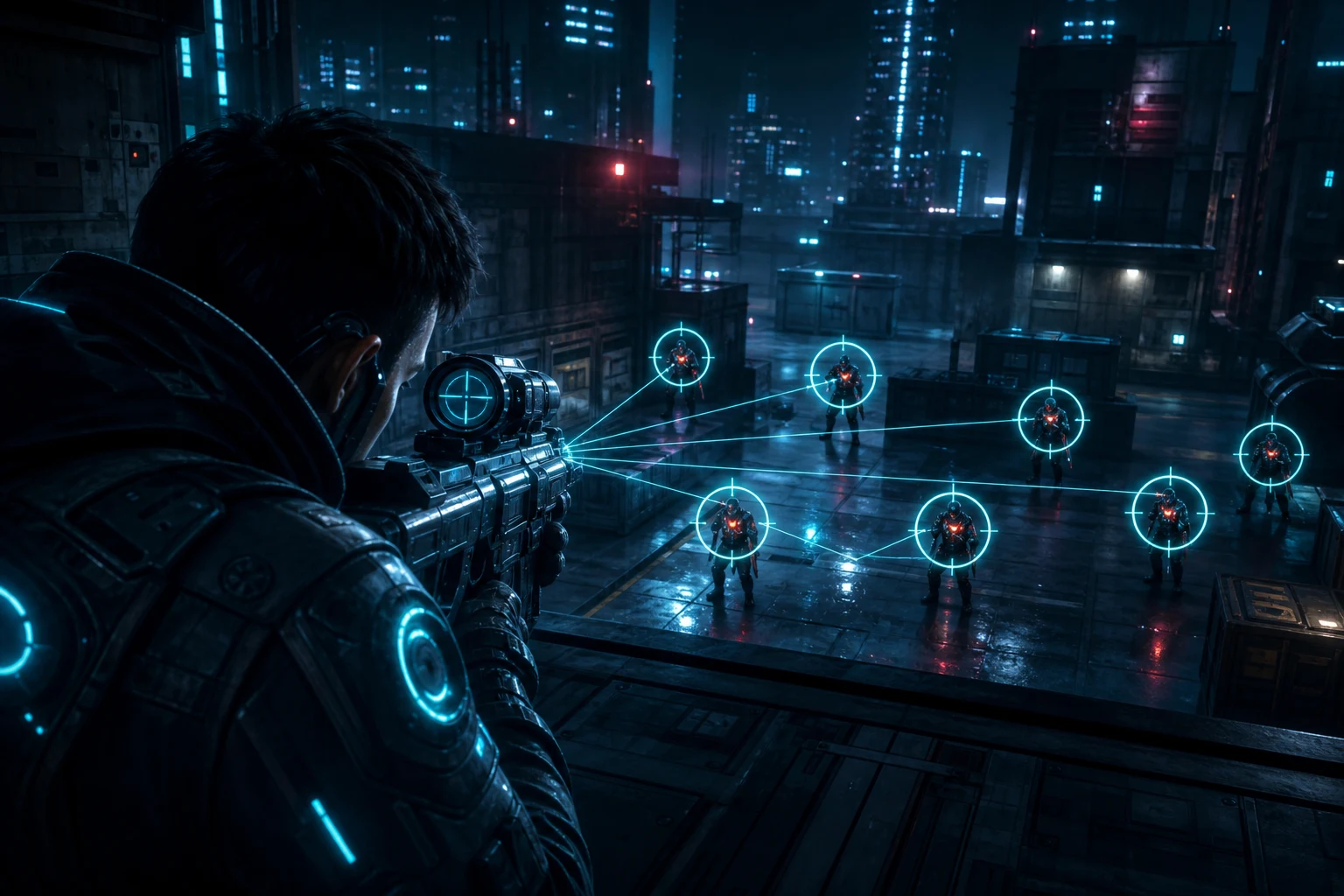
Memory-based aimbot is one of the most common and most powerful types of aimbots. In this method, the cheat software directly accesses the game's memory to read enemy player 3D coordinates, bone positions, and other critical data.
How It Works: In Windows operating systems, the game's process memory is read via the ReadProcessMemory API or kernel-level drivers. After finding the game's base address, pointer chains are followed to reach the player list, each player's position data, and other critical information.
Advantages:
- Works independently of screen resolution and visual quality.
- Can detect enemies behind walls (when combined with wallhack).
- Operates with very low latency.
Disadvantages:
- Offsets need to be updated with every game update.
- Anti-cheat systems actively monitor memory reading operations.
- Requires additional measures against kernel-level anti-cheats (Vanguard, Easy Anti-Cheat).
2. Screen-Based Aimbot
Screen-based aimbot works by analyzing only the screen image without touching game memory at all. This method has advantages in bypassing some anti-cheat systems since it doesn't require memory manipulation.
How It Works: Game images are captured using screen capture APIs (GDI, DirectX hook, or modern GPU-based capture). Then, color analysis or image processing algorithms detect enemy players. The screen coordinates of detected targets are converted into mouse movement.
In simple implementations, specific color ranges are scanned (for example, the red color of enemy models). More advanced versions use machine learning models.
3. Triggerbot
Triggerbot is technically not an "aimbot," but it's an integral part of the aimbot ecosystem. Triggerbot automatically fires when the crosshair is positioned over an enemy.
How It Works: Two basic methods exist:
- Color-based: Fire when the pixel color under the crosshair changes to an enemy model color.
- Memory-based: Read the game's "crosshair entity ID" value; fire when this value points to an enemy.
Triggerbot is particularly popular in games like CS:GO/CS2 because it doesn't require mouse movement and is therefore harder to detect.
4. Silent Aim
Silent aim is one of the most sophisticated and hardest-to-detect aimbot techniques. In this method, visually the player's aim doesn't appear to be on the target; however, the aiming angle is manipulated in packets sent to the server.
How It Works: Through network packet manipulation or by hooking game functions, the angle information sent to the server when firing is altered. The player might be looking in a completely different direction on screen, but in server records, the target appears to be hit.
Important Note: Silent aim can be caught by server-side anti-cheat systems that detect abnormal angle values. Additionally, it appears very obviously in demo recordings.
5. Bone-Based Aimbot
Bone-based aimbot targets specific bone points in the enemy player's skeletal structure (head, chest, neck, etc.). This provides precision far beyond simple center-point targeting.
How It Works: Modern games store the skeletal structure of each character model in memory. This skeleton typically consists of 30-60 bone points. The aimbot reads the 3D coordinates of these bone points and selects the most suitable target point, aiming at that point.
Target Selection Strategies:
- Head-only: Targets only the head bone; for maximum damage.
- Closest bone: Targets the bone closest to the crosshair; for more natural appearance.
- Highest damage: Selects the best bone based on instant damage calculation.
6. Prediction Aimbot
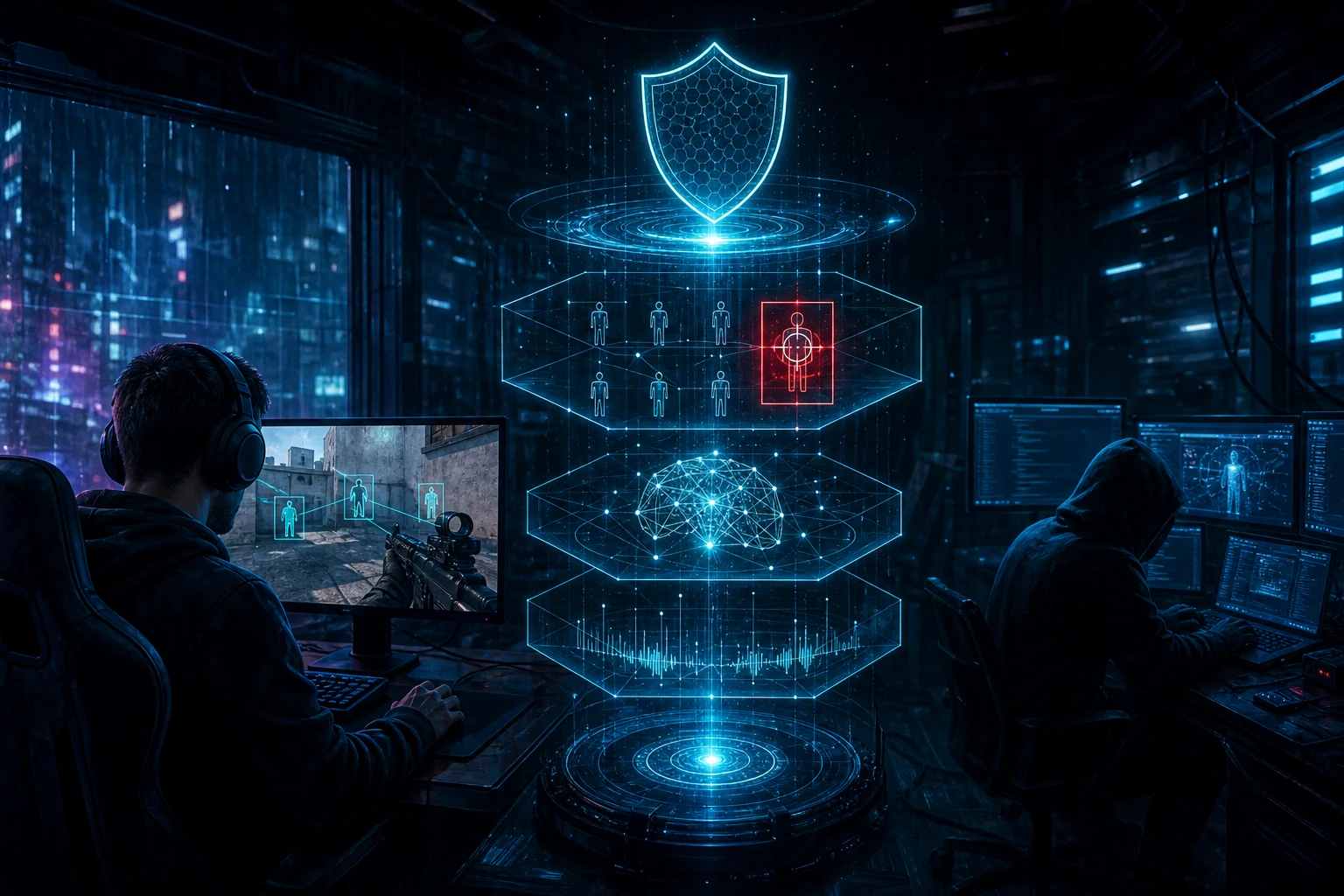
Prediction aimbot calculates and aims at where the target will be in a few milliseconds, rather than where it currently is. This provides a major advantage, especially against high ping values or fast-moving targets.
How It Works: The target's velocity vector is calculated from the last few frames. This vector is combined with bullet travel time and network latency to predict the target's future position. The aimbot aims at this predicted point.
Mathematical Foundation: Basic kinematic equations are used:
Predicted Position = Current Position + (Velocity × Time)
More advanced versions also account for acceleration, gravity, and character animation cycles.
7. FOV Aimbot
FOV (Field of View) aimbot only locks onto targets within a specific radius of the crosshair. This makes the aimbot appear more natural and reduces detection risk.
How It Works: Among all visible enemies, only those within a specific angle of the crosshair (for example, 5°, 10°, 30°) are considered. This angle is configurable as the "FOV value." Lower FOV values are less noticeable but less effective; higher FOV values are more effective but more suspicious.
8. Smoothing Aimbot
Smoothing aimbot smooths mouse movement in a human-like manner, eliminating sudden and suspicious movements. This is one of the most important "legit" (legitimate-looking) aimbot features.
How It Works: Instead of raw aimbot output, mouse movement is passed through an interpolation algorithm. Common methods include:
- Linear interpolation: Constant-speed movement toward the target angle.
- Bezier curves: Creates natural curved movements.
- Exponential smoothing: Movement that slows as it approaches the target.
The higher the smoothing value, the slower and more natural the mouse movement appears; however, the aimbot's effectiveness also decreases.
9. AI-Based Aimbot
The most modern and advanced type of aimbot, AI-based aimbot uses deep learning models for enemy detection. This method is theoretically more resistant to kernel-level anti-cheat systems since it doesn't require memory access.
How It Works: Object recognition models like YOLO (You Only Look Once) or ResNet detect enemy models on the game screen in real-time. The center of detected bounding boxes or a specific point (for example, the head region) is targeted.
Hardware Requirements: AI-based aimbots require powerful GPUs for real-time inference. NVIDIA's TensorRT optimization or custom CUDA kernels are used to minimize latency.
Anti-Cheat Systems and Bypass Methods
Modern anti-cheat systems employ a multi-layered approach to aimbot detection. Understanding these systems is critical for both security researchers and cheat developers.
Major Anti-Cheat Systems
- VAC (Valve Anti-Cheat): Valve's system; scans for specific signatures and behavior patterns. Takes a reactive approach.
- Easy Anti-Cheat (EAC): Epic Games' system; uses a kernel-level driver and monitors memory integrity.
- BattlEye: Used particularly in PUBG and Rainbow Six Siege; performs active scanning and behavior analysis.
- Vanguard (Riot): System developed for Valorant; a kernel-level driver that runs from system startup.
Behavioral Analysis and Machine Learning
Modern anti-cheat systems no longer rely solely on signature-based detection. Machine learning models that analyze player behavior examine abnormal aiming patterns, reaction times, and mouse movements to identify suspicious players.
For this reason, smoothing and FOV limitations have become essential components of modern aimbots.
Aimbot Development: Technical Requirements
If you want to develop your own aimbot software, you'll need the following technical knowledge and tools:
Programming Languages
- C++: Preferred language for low-level memory access and maximum performance.
- C#: Useful for Windows API integration; however, slower than C++.
- Python: Ideal for AI-based aimbots; powerful ecosystem with PyTorch and OpenCV.
- Rust: Modern alternative offering safe memory management and high performance.
Essential Libraries and Tools
- Windows API: ReadProcessMemory, WriteProcessMemory, SendInput
- DirectX/OpenGL hooks: For screen capture and overlay rendering
- OpenCV: For image processing-based aimbots
- Cheat Engine: For offset finding and memory analysis
- x64dbg / IDA Pro: For reverse engineering
Mathematical Foundation
A strong 3D mathematics foundation is essential for aimbot development:
- World-to-screen projection: Converting 3D world coordinates to 2D screen coordinates
- Angle calculation: Calculating yaw/pitch angles using the atan2 function
- Vector mathematics: Velocity vectors and prediction calculations
- Matrix transformations: View matrix and projection matrix operations
Ethical and Legal Dimensions
When discussing aimbot technology, it's impossible to ignore the ethical and legal dimensions. This technology can cause serious harm to gaming communities and may face legal consequences in many countries.
Using or distributing aimbot:
- Violates the Terms of Service of virtually all games and can result in permanent bans.
- May be evaluated under computer fraud or unauthorized access laws in some countries.
- Game companies can pursue legal action against cheat software developers.
For this reason, we recommend examining aimbot technology only for educational, security research, and academic purposes.
Conclusion: The Future of Aimbot Technology
Aimbot technology is the product of an ongoing arms race between game security and cheat software developers. This evolution, ranging from memory-based methods to AI-powered systems, represents one of the most fascinating intersections in software engineering.
In the future, AI-based aimbots are expected to become increasingly prevalent. On the other hand, anti-cheat systems are also developing more sophisticated defenses against these threats through machine learning-based behavior analysis.
Understanding aimbot technology is extremely valuable for game security researchers, game developers, and cybersecurity experts. Following developments in this field provides better understanding of game security from both defensive and offensive perspectives.
Frequently Asked Questions (FAQ)
Is aimbot legal?
Using aimbot violates the Terms of Service of virtually all games and results in account bans. In some countries, it may be evaluated under computer crime laws. While legal status varies from country to country, commercial distribution carries serious legal risks.
Can aimbot bypass anti-cheat systems?
Modern aimbots can bypass some anti-cheat systems using techniques like kernel-level drivers, memory signature hiding, and behavioral masking. However, advanced systems like Vanguard and EAC are constantly updated to implement countermeasures against these techniques.
Which type of aimbot is hardest to detect?
"Legit" aimbots using low FOV values, high smoothing, and human-like latency are the hardest to detect. AI-based aimbots also have advantages against some systems since they don't require memory access.
Which programming language should be learned to develop aimbot?
C++ is the best choice for memory-based aimbots. Python with PyTorch is ideal for AI-based aimbots. Basic Windows API knowledge and 3D mathematics are mandatory for both approaches.
Why is prediction aimbot superior to others?
Prediction aimbot accounts for network latency and target movement to enable more accurate shots. Especially against high ping values or fast-moving targets, it's much more effective than standard aimbots.
Share this post
10 Effective Ways to Succeed with Game Cheats
Gaming Cheat Strategies: Tier List Guide 2024
// related posts
Related Posts
Marvel Rivals Aimbot Experience: The Path to Quick Wins
Discover how aimbot and other cheat tools work in Marvel Rivals, which features will give you the edge, and how to choose the right tool for your playstyle.
October 9, 2026
Rust ESP Map Control: Seeing Enemy Positions in Advance
Master map control in Rust using ESP to see enemy positions beforehand. Discover optimal settings, profiles, and strategies for dominating the game in this comprehensive guide.
October 8, 2026

PUBG Final Circle: Best Settings and Strategies to Win
Struggling in PUBG's final circle? Master the right cheat settings and configurations to turn every endgame in your favor. Complete guide to dominating the final zone.
October 8, 2026